Differential pressure is one of the most useful indirect measurements in a plant: it reveals a clogging filter, a leaking duct, a tank level or a flow rate depending only on where the two impulse lines are connected. The DPT-600 is built for that flexibility. Two isolated ports feed a single sensing capsule, while the electronics convert the tiny deflection into a standard industrial signal. Because the same hardware covers several tasks, panel builders can standardise on one part across many machines.
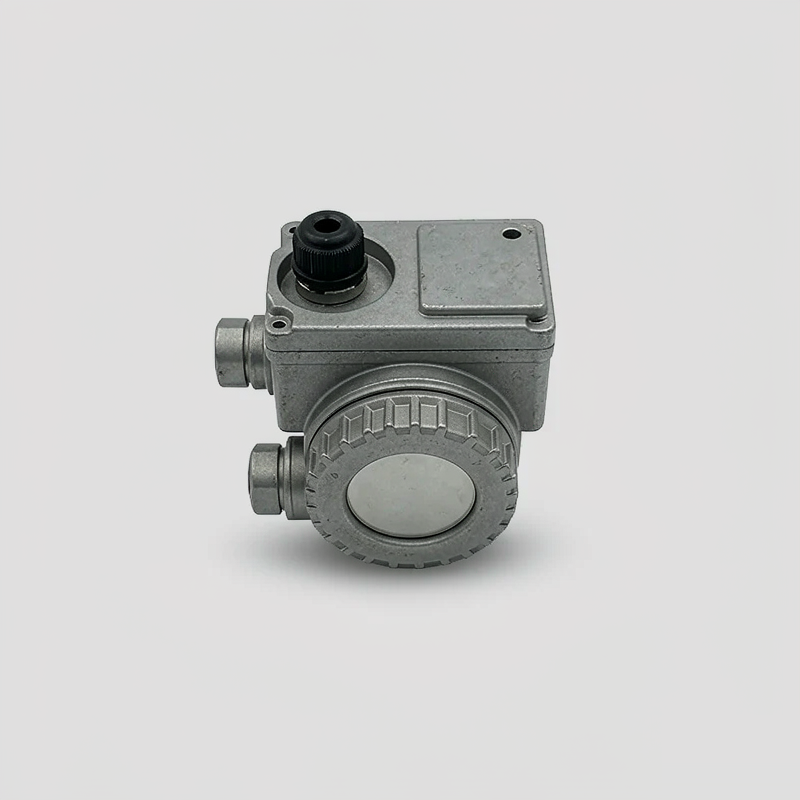
Two 316L stainless diaphragms are welded to a central measurement cell filled with a silicone transfer fluid, so the sensing element never touches the process media directly. The cell sits inside a die-cast aluminum housing with a screwed cover and a gasket rated for outdoor use. High and low pressure ports are clearly marked and offered with G1/8 or G1/4 female threads, and an optional bracket supports wall or rail mounting. Terminal blocks and a cable gland sit in a separate chamber from the electronics.
The standard 0 to 600 mbar range can be factory scaled to lower spans, with total accuracy better than 0.25 percent of full scale including hysteresis and thermal effects. Allowable static pressure reaches 20 bar, so the transmitter survives on pressurised lines, and one sided overload protection prevents diaphragm damage during commissioning errors. Output is two wire 4 to 20 milliamps or RS485 with an open register description; adjustable damping smooths pump pulsation. Long term drift is low enough for annual calibration intervals in most installations.
Connect the higher pressure to the port marked H and keep both impulse lines short, sloped and free of trapped liquid. Mount the housing vertically with the gland pointing down so condensation drains away, and use a manifold with equalising valve if zero checks are frequent. Open the equalise valve before applying static pressure, then set zero with both ports at the same pressure. In dusty service, fit impulse line filters and plan a periodic purge.
Each transmitter includes a calibration certificate at five points, a port identification drawing and mounting hardware. Range, output type, thread form and bracket style are configured before sealing the housing, so they should be fixed on the order. A local display and a valve manifold are available as accessories. For projects with many units, identical ranges and damping settings can be preloaded to shorten on site commissioning.