Small weighing modules usually fail because the sensor is too large for the mechanism, not because the electronics lack resolution. The MP-5 addresses that by shrinking a proven parallel beam structure into a thin aluminum package that fits under a tray only a few centimetres wide. Despite its size it compensates for off-center loading, so one cell can replace a four sensor arrangement in portable scales, micro dispensers and compact medical instruments where battery power and board space are both limited.
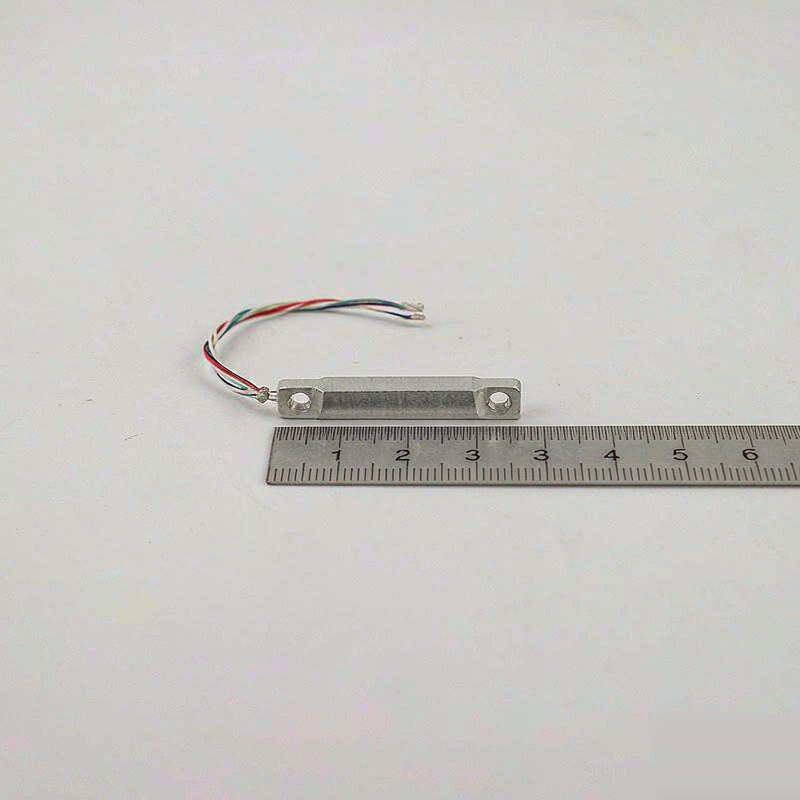
The element is milled from fine grained aluminum alloy and colourless anodized to resist oxidation. Two miniature mounting holes at each end accept M3 screws, and the strain gauges are bonded to the reduced web section before being covered with a thin protective film. A flexible four wire ribbon exits from one side rather than the end, which helps when the cell is mounted close to a printed circuit board. Custom lead lengths and a small connector option simplify automated assembly.
Capacities from 500 grams to 5 kg share the same outline, with a nominal 1.0 to 2.0 mV/V output depending on the variant. Combined error stays within 0.05 percent of full scale, and the low mass of the element gives a fast mechanical response suitable for dynamic dosing. Excitation of 3 to 5 volts keeps power draw low for battery instruments, and the compensated range is minus 10 to plus 40 degrees Celsius. Safe overload is 120 percent, so the tray should be protected from dropped objects.
Use a flat rigid support and M3 screws tightened gently; over torquing the tiny threads distorts the beam and shifts the zero. Keep the platform small and centred, since the recommended maximum is only 100 by 100 millimetres. Avoid routing the ribbon across a moving joint, and add a mechanical stop so an accidental overload cannot bend the web. Calibrate with small certified weights at room temperature, then recheck zero after the enclosure is closed.
Units are packed in anti static trays with a calibration record and a handling note describing the overload limit. Because the ribbon cable is fragile, connectorised versions are recommended for automated production. Custom capacities, cable exit positions and mounting hole patterns can be released against a sample approval drawing. Evaluation kits containing three capacities and a small amplifier board are useful during early prototyping.